Showing posts with label Year 2004. Show all posts

Tuesday, March 19, 2013

Bird Life Festival 2004, Solomon Part 2


Following the previous issue in this blog,  World Bird festival 2004 (Kingfisher) – Solomon Islands Part II  , detail of the depicted bird species on each stamps comprises of the Beach Kingfisher (Todiramphus saurophaga), the Collared Kingfisher (Todiramphus chloris),  the Ultramarine Kingfisher (Todiramphus leucopygius), the Moustached Kingfisher (Actenoides bougainvillei), the Little Kingfisher (Alcedo pusilla), and the Variable Dwarf Kingfisher (Ceyx lepidus), described in the next paragraphs.


The Beach Kingfisher (Todiramphus saurophaga) is a species of bird in the Alcedinidae family and found in Indonesia, Papua New Guinea, and Solomon Islands.
Its natural habitat is subtropical or tropical mangrove forests.
The population trend appears to be stable and for these reasons the species is evaluated as Least Concern.


Monday, March 18, 2013

Bird Life Festival 2004 , Solomon Part 1


Following the previous issue : World Bird Festival 2004 (Purple Swamphen etc) – Solomon Islands Part I, in this blog, detail of each stamps which depicting species  of The Rufous-tailed Waterhen (Amaurornis moluccana), The Buff-banded Rail (Gallirallus phillapensis), The Purple Swamphen (Porphyrio porphyrio), Woodford's Rail (Nesoclopeus woodfordi), The Roviana Rail (Gallirallus rovianae), The Makira Woodhen (Gallinula silvestris) described in the next paragraph.


The Rufous-tailed Waterhen (Amaurornis moluccana), is a species of bird in the Rallidae family.

The population trend is not known, but the population is not believed to be decreasing sufficiently rapidly, therefore the species is evaluated as Least Concern.
 
It is found in Indonesia, Papua New Guinea, Australia and the Solomon Islands. Its natural habitat is subtropical or tropical moist lowland forests.
 

Tuesday, February 8, 2011

Birdlife Stamps of St. Lucia - 2004

To continue  the previous issue of the title " Birds of St. Lucia 2004 ", explanation of 8 stamps are issued for celebration  the Unique Caribbean treasures in the following  paragraphs. The issuance comprised of 8 stamps and all stamps featured the protected bird of St.Lucia, Antillean Crested Hummingbird, Lesser Antillean Pewee , Purple-throated Carib , Grey Trembler,Rufous-throated Solitaire,St. Lucia Warbler,  Antillean Euphonia, Semper's Warbler.

stl200401l
1$    Antillean Crested Hummingbird    Orthorhyncus cristatus
The Antillean Crested Hummingbird (Orthorhyncus cristatus) is a species of hummingbird in the Trochilidae family. Its natural habitats are subtropical or tropical moist lowland forests and heavily degraded former forest.
It is found in Anguilla, Antigua and Barbuda, Barbados, Dominica, Grenada, Guadeloupe, Martinique, Montserrat, north-east Puerto Rico, Saba, Saint-Barthélemy, Saint Kitts and Nevis, Saint Lucia, Saint Martin, Saint Vincent and the Grenadines, Sint Eustatius, the British Virgin Islands and the U.S. Virgin Islands.
.
stl200402l
1$    Lesser Antillean Pewee    Contopus latirostris
The Lesser Antillean Pewee (Contopus latirostris) is a species of bird in the Tyrannidae family. It is found in Dominica, Guadeloupe, Martinique, Puerto Rico, and Saint Lucia with records from Saint Kitts. Its natural habitats are subtropical or tropical dry forests, subtropical or tropical moist lowland forests, and subtropical or tropical moist montanes.

Monday, December 20, 2010

The House Martin as Belarus Bird 2004.

On March 31, 2004 Belarus Post issued the stamp from the series “A bird of the year” dedicated to the House Martin. The stamp is issued under the aegis of the International organization of birds protection “BirdLife International” and Belarus organization “Ahova ptushak Belarusi” (APB “Protection of Belarus Birds”).

bel200401l

image


The Common House Martin (Delichon urbicum), sometimes called the Northern House Martin or, particularly in Europe, just House Martin, is a migratory passerine bird of the swallow family which breeds in Europe, north Africa and temperate Asia; and winters in sub-Saharan Africa and tropical Asia.
It feeds on insects which are caught in flight, and it migrates to climates where flying insects are plentiful. It has a blue head and upperparts, white rump and pure white underparts, and is found in both open country and near human habitation.
The preferred habitat of the Common House Martin is open country with low vegetation, such as pasture, meadows and farmland, and preferably near water, although it is also found in mountains up to at least 2,200 metres (7,200 ft) altitude.
The Common House Martin is a migrant which moves on a broad-front.While migrating they feed in the air on insects and they generally travel in daylight, although some birds may move at night.The Common House Martin is a noisy species, especially at its breeding colonies. The male's song, given throughout the year, is a soft twitter of melodious chirps. The contact call, also given on the wintering grounds, is a hard chirrrp, and the alarm is a shrill tseep.
It is hunted by the Eurasian Hobby (Falco subbuteo), and like other birds is affected by internal parasites and external fleas and mites, but its large range and population mean that it is not threatened globally.

Friday, November 12, 2010

Bristle-thighed Curlew of Kiribati. 2004

Page 49
The Bristle-thighed Curlew, Numenius tahitiensis, is a large shorebird that breeds in Alaska and winters on tropical Pacific islands. The distinctive has characterized are long and decurved bill, bristled feathers at the base of the legs, spotted brown on the upper body with a light belly and ruswte-colored , buffy tail and length is about 43 cm.
Bristle-thighed Curlews feed on a wide variety of vegetation such as flowers and berries and on insects, sea life, and other bird's eggs, which they use rocks to break open—the only tool use among shorebirds.The population is estimated at 7,000 birds
 
.

Thursday, November 11, 2010

Birdlife of Fiji 2004.

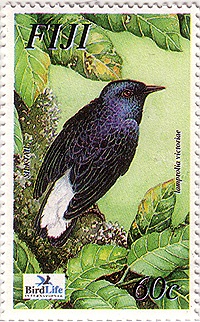
Fiji Post has collaborated with Birdlife International Organization released the birdlife stamp series depicted species Longlegged wrabler, Silktail, Pink-billed Parrotfinch, and Red-throated Lorikeet on year 2004.

fiji1
Long legged warbler,or known  Trichocichl rufa have distinctive are 17 cm in length with a long-tailed secretive warbler of the forest floor. Upper parts rather warm brown with a distinct long fine silvery super-cilium. White throat contrast with buffy-rufous breast-sides and flanks, fading into an off-white belly. Fairly long bluish legs, and medium-short black bill.This species is endemic Viti Levu and Vanua Levu on Fiji. This species was recently rediscovered and has been listed as Endangered because it is estimated to have a very small population, approximately 50 – 249 birds.


fiji2

The Silktail, Lamprolia victoriae is a small black bird 12cm with rounded long wings, iridescent metallic blue crown and breast, silky white lower-back patch and white rounded pattern of short tail. The Silktail is endemic to forests of Taveuni and Vanua Levu islands of Fiji.  This species is classified as Near Threatened because   declining owing to losses of mature forest through continuing logging, plantation establishment and clearing for agriculture. Population estimated between 16,000 - 28,000 birds.


fiji3
The Pink-billed Parrotfinch,  Erythrura kleinschmidti , is approximately 11 cm long, robust, greenish finch with outsized bill.It is mainly found in mature, wet forest up to 1,000 m, sometimes found in secondary scrub and plantations. The species has olive-green with black face, bluish crown and nape and red rump. This species is restricted to a single subpopulation on the island of Viti Levu in Fiji and qualifies as Vulnerable because  the population is still small, and declining owing to habitat loss. The population estimated between 2,500-9,999 birds.


fiji4

The Red-throated Lorikeet or Charmosyna amabilis , has 18 cm long and entirely green but for red cheeks, throat and thighs. Red throat bordered with yellow. Mustard-yellow undertail and tail tips.High-pitched squeaks uttered whilst feeding or in flight.This species qualifies as Critically Endangered lorikeet because a tiny population and continuing to decline as a result of predation from introduced rats and loss of habitat. It is endemic to Fiji and found in the islands of Viti Levu, Vanua Levu, Taveuni and Ovalau. Population estimated is less than 50 birds.

Friday, October 1, 2010

World Bird Festival 2004 (Purple Swamphen etc) – Solomon Islands Part I

Page 61

World Bird festival 2004 (Kingfisher) – Solomon Islands Part II

Page 60

Word Bird Festival 2004 (Owl Birds )– Solomon Islands Part III

Page 59

Birds of Saint Lucia - 2004

Page 53


On June 30 , 2004, Saint Lucia Post collaborated with the Birdlife International organization, have  issued  the protected species of birds from their country  to celebrate the Unique Carribean treasures.    The  issue comprise of eight  postage  stamps  depicted  the bird species as follows:

  • Top row :  Antillean Crested Hummingbird   ( Orthorhyncus cristatus),   Lesser Antillean Pewee    (Contopus latirostris) ,  Purple-throated Carib    (Eulampis jugularis),  Grey Trembler    (Cinclocerthia gutturalis), 
  • Bottom Row:  Rufous-throated Solitaire    (Myadestes genibarbis),  St. Lucia Warbler    (Setophaga delicata),   Antillean Euphonia    (Euphonia musica),  Semper's Warbler    (Leucopeza semperi).

To be continued in more detail in the next issue.

Friday, September 24, 2010

Masked Booby – Ascension Island 2004

Page 42 

The Masked Booby has been featured on the stamps that has issued by Ascension Island on year 2004 with the collaboration of Birdlife International. The logo of Birdlife International and RSPB marked on stamp.

The Masked Booby, Sula dactylatra, is a large seabird of the gannet family, Sulidae. This species breeds on islands in tropical oceans, except in the eastern Atlantic. The Masked Boobies are spectacular divers, plunging diagonally into the ocean at high speed. They mainly eat small fish, including flying fish.

The Masked booby is the largest booby, at 81–91 cm long, and with a 152 cm wingspan and 1500 g weight.The distinctive characteristics are white colour with pointed black wings, a pointed black tail, and a dark grey facemask. The male has a yellow bill and the female’s is greenish yellow. Juveniles are brownish on the head and upperparts, with a whitish rump and neck collar. The underparts are white.
Related Posts Plugin for WordPress, Blogger...